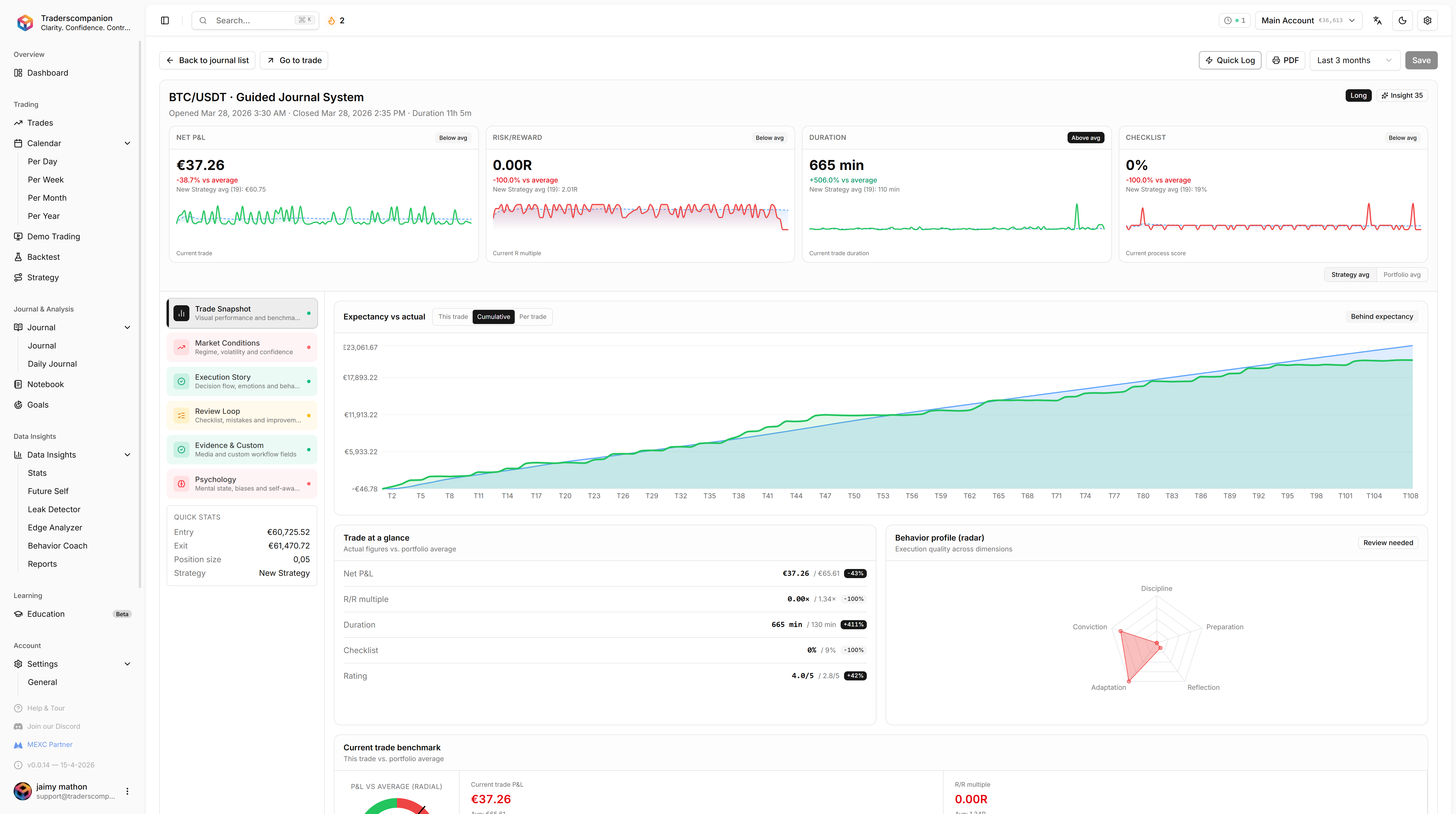
The Ultimate Trading Journal Guide: How to Improve Your Trading Performance

Written by
TradersCompanion Team
Why Every Serious Trader Needs a Trading Journal
If you’re serious about becoming a profitable trader, there’s one tool you can’t ignore:
A trading journal.
Most traders focus on strategies, indicators, and market conditions. But the real difference between winning and losing traders comes down to something much simpler:
Tracking, analyzing, and improving your behavior.
The Problem: Trading Without Data
Imagine running a business without tracking revenue, costs, or performance.
That’s exactly what most traders are doing.
They:
Take trades based on gut feeling
Forget why they entered or exited
Repeat the same mistakes
Have no clear idea what actually works
This leads to inconsistency — and ultimately, losses.
What Is a Trading Journal?
A trading journal is a structured way to record and review your trades.
But it’s more than just numbers.
A good journal tracks:
Entry and exit points
Trade setup and reasoning
Risk management
Emotions during the trade
Outcome and lessons learned
This turns random trading into a data-driven process.
How a Trading Journal Improves Your Performance
1. You Identify What Actually Works
Instead of guessing, you’ll see:
Which setups are profitable
Which markets suit you best
What times you perform best
2. You Eliminate Costly Mistakes
Patterns become obvious:
Overtrading
Revenge trading
Ignoring your plan
Once you see them, you can fix them.
3. You Build Real Consistency
Consistency doesn’t come from a perfect strategy.
It comes from:
Repeating what works
Avoiding what doesn’t
A journal makes this possible.
4. You Gain Emotional Control
By tracking your emotions, you’ll notice things like:
Fear causing early exits
Greed causing overtrading
Awareness leads to control.
What to Track in Your Trading Journal
To get real value, track at least:
Trade idea and setup
Entry and exit price
Risk-to-reward ratio
Position size
Emotions before, during, after
Screenshot of the chart
Final result + lesson learned
The more structured your data, the faster you improve.
Common Mistakes Traders Make
Even when traders use a journal, they often do it wrong:
Only tracking winning trades
Not reviewing regularly
Writing vague notes
Ignoring emotional data
A journal only works if you use it consistently and honestly.
How to Start Today (Simple System)
You don’t need anything complicated.
Start with this:
Log every trade
Add 1–2 sentences of reasoning
Review your trades weekly
Look for patterns
Improve one thing at a time
Small improvements compound fast.
Final Thoughts
A trading journal won’t make you profitable overnight.
But it will do something more important:
It will turn you into a consistent, disciplined trader.
And that’s what actually leads to long-term success.
If you want to stop guessing and start improving your trading performance:
With Traders Companion, you can track your trades, identify patterns, and build consistency — all in one place.